

 Tour in Beijing - Beijing Dining and Restaurant
Aiwowo
2011-10-28 11:22
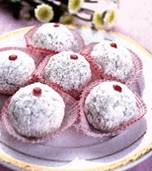
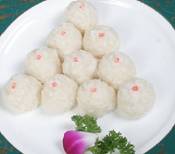
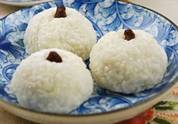
Aiwowo is also one of traditional snacks of Beijing, and it is served around the Lunar New Year up to the end of summer or the beginning of autumn at snack bars of Beijing. Although Aiwowo was served in spring and autumn, it is offered in all seasons now. Aiwowo enjoys a long history. Liu Ruoyu, an eunuch at Wanli Era of the Ming Dynasty, wrote in his Zhuozhongzhi that “Lianggao (cake made of glutinous rice served cold in summer) is made of glutinous rice and sesame; if it is made into balls with stuffing inside, it will be served as Aiwowo, known as Buluojia in the past.” It is thus known that this snack is made according to the following steps - wash and immerse glutinous rice into water, steam it in food steamer until it is done, knead and make it into small pieces after its cooling down, press it into round film, and then fill it with shelled walnuts, sesame, shelled melon seeds, greengage, haw jelly and white sugar.
It was called “Wowo” at Wanli Era in the Ming Dynasty. But why is it called “Aiwowo” afterwards? The answer is found in Explanations of Proverbs by Li Guangting, a writer in Qing Dynasty: there has been one emperor who loved this Wowo, and when he wanted to have some, he would say: “I love (“Yu ai” in Chinese pronunciation) Wowo.” When this snack was introduced among the people, folks did not dare to say “Yu” (meaning the emperor), so they called it “Aiwowo.” This snack has been popular among common people in the Ming Dynasty, and in The Golden Lotus, a famous novel in Ming Dynasty, Aiwowo is recorded as one of popular snacks at that time.
Copyright 2005-2020 www.sdlm.cn All Rights Reserved Design by Sdlm.Cn 京ICP备13030516号
E-mail:Hotel@sdlm.cn TEL:8610-68372681 8610-68372682
E-mail:Hotel@sdlm.cn TEL:8610-68372681 8610-68372682