
 Classic Lines
Emperor Qin Shihuang’s Mausoleum
2011-10-28 17:40
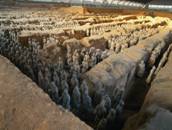
The height of the terra-cotta warriors varies from 1.78m, the shortest, to 1.97m, the tallest. They look healthy and strong and have different facial expressions. Probably they were sculpted by craftsmen according to real soldiers of the Qin dynasty. They organically combined the skills of round engraving, bas-relief and linear engraving, and utilized the six traditional folk crafts of sculpturing, such as hand-moulding, sticking, cutting, painting and so on. The clay models were then put in kilns, baked and colour-painted.
As the terra-cotta figures have been burnt and have gone through the natural process of decay, we can’t see their original gorgeous colors. However, most of the terra-cotta figures bear the trace of the original colors, and few of them are still as bright as new. They are found to be painted by mineral dyestuffs of vermilion, bright red, pink dark green, powder green, purple, blue, orange, black and white colors.
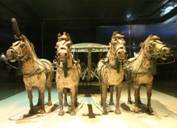
Thousands of real weapons were unearthed from these terra-cotta army pits, including broad knives, swords, spears, dagger-axes, halberds, bows, crossbows and arrowheads. These weapons were exquisitely made. Some of theme are still very sharp, analyses show that they are made of alloys of copper and tin, containing more than ten kinds of other metals. Since their surfaces were treated with chromium, they are as bright as new, though buried underground for more than 2,000 years. This indicates that Qin dynasty’s metallurgical technology and weapon-manufacturing technique already reached quite a high level.Bronze chariot and horses now on display were found broken into 1,555 pieces when excavated. After two-and-half years’ careful and painstaking restoration by archaeologists and various specialists, they were formally exhibited in the museum on October 1, 1983. No.1 bronze chariot hand horses are on display from 1988
Copyright 2005-2020 www.sdlm.cn All Rights Reserved Design by Sdlm.Cn 京ICP备13030516号
E-mail:Hotel@sdlm.cn TEL:8610-68372681 8610-68372682
E-mail:Hotel@sdlm.cn TEL:8610-68372681 8610-68372682